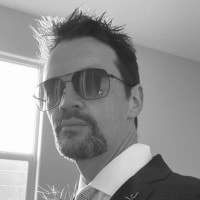

My Story
I took the long way around.
Eldorado, Illinois → Dallas → Austin → Los Angeles → Boston → Las Vegas
Chapter One
Where I Came From
I grew up in Eldorado, Illinois, a small town in the southern part of the state. When I was a kid, there were maybe 5,000 people there. Today there are considerably fewer.
My parents split up when I was around eight or nine. My mom was a waitress raising three kids, and for a while the four of us lived in a small trailer where she slept on the couch because there wasn't another bed.
We were poor. Not we didn't take fancy vacations poor. Food stamps and boxes of donated food around the holidays poor.
I don't say that because I had some miserable childhood. I didn't. I had friends. I had Star Wars and the Cardinals and professional wrestling. I had a mother who worked her ass off. And I always had this probably unreasonable belief that someday I was going to get out and do something interesting with my life.
I just had absolutely no idea what that was going to be.
Where I Came From
I was a smart kid and a pretty good test taker, but I wasn't the world's greatest student. Somewhere along the way I developed a serious dislike of homework, which is probably one of the less inspiring things you'll ever read in a personal biography.
I wasn't an athlete either.
Two of my best friends growing up, Jeremy and Joseph Parks, were fantastic distance runners. I'd occasionally try running with them and get my ass handed to me. The idea that I'd someday voluntarily train for a marathon would have been hilarious.
What I did have was curiosity.
Movies and television mattered enormously to me. So did music, comedy, sports and wrestling. Star Wars came out about three months after I was born, so I basically grew up alongside it. Star Wars books were among the things that helped me learn to read.
I was a Cardinals kid. Ozzie Smith might as well have been a superhero.
And people like George Carlin and Richard Pryor showed me pieces of a world that looked very different from southern Illinois.
I think popular culture helped me understand pretty early that the place where I happened to be born wasn't the entire world.
And I wanted to see the rest of it.
The Job That Wasn't Supposed to Become a Career
I attended community college for a while and discovered the internet in the mid-1990s.
Back when telling someone you met a person online still required an explanation, I did exactly that. It eventually helped take me from Illinois to Tennessee and then to Dallas.
Dallas felt enormous compared with where I'd come from.
For a short time I worked in telecommunications, investigating disputed long-distance calls. I liked the detective work—looking at records, numbers and patterns and trying to figure out what had actually happened.
Then that job disappeared.
I needed another one.
My then-wife and I had been inside an adult video store called New Fine Arts, and I remembered seeing a help-wanted sign.
So, around 1998, at about 21 years old, I applied.
It paid around seven bucks an hour.
I figured it would do until I found whatever I was actually going to do with my life.
That turned out to be a slight miscalculation.
Chapter Two
An Unconventional Career
"Unless You Want to Be President"
During my interview, the manager told me there was one unusual thing I needed to know about the job.
This was Dallas. This was Texas. Adult businesses sometimes got hassled by law enforcement. The store was licensed, paid taxes and operated openly, but there was a small chance that, as an employee, I could get arrested.
The company would cover the legal costs.
And, she told me, it wouldn't really affect my future—unless I wanted to be president or something.
I'd recently watched The People vs. Larry Flynt, so 21-year-old me thought something along the lines of: Well, shit. If that happens, I'll be Larry Flynt. I'll fight for the First Amendment.
What she probably should have told me was: You're going to get arrested. A lot.
During my years at New Fine Arts, I was arrested 11 times in connection with obscenity cases involving adult videos.
Usually there would be a warrant, I'd turn myself in, spend several miserable hours dealing with the process, and the company's attorneys would handle the case.
Then something interesting happened.
A former employee got caught up in a case involving a sale he'd made before leaving the company. Because he had reasons of his own for not wanting another charge on his record, he hired a different attorney and fought it.
The case went away.
Those of us still working at the store had essentially the same reaction: Wait. We can do that?
So we decided to fight too.
Eventually I had a case involving two movies that went all the way to a jury.
I was found not guilty.
There is probably a longer story to tell about that period someday. But one lesson stayed with me: Sometimes everybody "knows" how a system works because everybody keeps doing what they've always done. It's worth asking whether they're actually right.
That lesson would become pretty important later.
"Sometimes everybody "knows" how a system works because everybody keeps doing what they've always done. It's worth asking whether they're actually right."
Trying to Leave the Adult Business
By then, New Fine Arts had become more than a temporary job.
I had moved up and started assisting the buyer. I learned about wholesale distribution, studios, pricing, inventory and the economics of the adult entertainment business.
But after several years, I was ready to try something else.
I moved to Austin and planned to get a mainstream job involving money or finance.
There was a problem.
Those arrests I'd been told wouldn't affect my future unless I wanted to become president? They affected my future.
My record made the kinds of financial jobs I was pursuing difficult to get.
So I found myself looking for work again.
An adult retailer in Austin called Dreamers was hiring.
The pay was around $15 an hour, which was pretty damn good for someone without a college degree.
So the first serious attempt I made to leave the adult industry ended with me going right back into it.
In retrospect, I'm glad it did.
Finding Out What I Was Good At
I started at Dreamers behind the counter despite already having years of experience.
Eventually I became an assistant manager and handled stocking for the Austin stores.
Then management changed unexpectedly, and the owner, Doug, asked me to become the company's buyer.
That job changed my career.
The philosophy I'd inherited seemed to be: buy the cheapest stuff possible and sell it for as much as possible.
I thought that was backwards.
Customers weren't stupid. Give them better products at reasonable prices and maybe they'd buy more of them.
So that's what I tried.
It worked.
I also started moving more of our purchasing directly to studios rather than relying entirely on distributors. That meant better pricing, better service and, just as importantly, direct relationships with the people making the products.
I became obsessive about data.
I spent hours in spreadsheets and databases tracking what sold, what didn't, how things were priced and where they were placed.
If a studio asked why its movie wasn't selling, I didn't have to shrug and say, "I don't know." I could show them.
And I learned another lesson that stuck with me: Be impeccable with your word.
If I said I'd place an order, I placed it. If I agreed to something, I did it. We paid our bills.
It sounds ridiculously simple.
It's amazing how far simply doing what you say you're going to do can take you.
Becoming Someone Worth Quoting
When I first worked at New Fine Arts, I used to read the adult industry's trade publications.
I'd see buyers and executives quoted in AVN and wonder what it would be like to be important enough that somebody cared what I thought.
Once I became the buyer at Dreamers, I decided to figure out how that worked.
I built relationships with people in the trade press, including AVN writer Nelson Ayala. Eventually I became one of the buyers AVN called when it wanted a retail perspective.
I appeared in its retail coverage and became involved in supplying real sales information from our stores.
For the kid who'd once stood behind the counter reading the magazine, that was already pretty cool.
I didn't know I'd eventually end up writing for it.

Chapter Three
The Long Way to Takedown Piracy
Los Angeles
Eventually I moved to Los Angeles and went to work for a company called Hush Hush Entertainment—the company behind Shane's World.
I was hired as a salesman.
I'd spent years on the retail and buying side. Now I was learning the other half of the business—how studios sold to the stores I used to buy for.
I was good at it.
I understood what buyers needed because I'd been one. I knew what sold, what didn't, and how to talk to someone who was trying to manage inventory and margins at the same time.
The owner of Hush Hush was a man named Andrew. He was the one who had brought me out to California to work for the company. We didn't always see eye to eye—we butted heads sometimes—but Andrew looked out for me in ways I didn't fully appreciate until later.
Before I moved into the RV, when I was traveling alone on the road for the company, Andrew would call and check on me regularly. I was isolated during that period in a way that's hard to explain. The work was relentless, the industry was contracting, and there were long stretches where those calls were about the only real human contact I had. There was something almost paternal about the way he kept tabs on me. I wouldn't go so far as to call him a father figure—that's not quite right—but he gave a damn, and that mattered.
The Recession and the Road
Then the economy fell apart.
The 2008 recession hit the adult entertainment industry hard. DVD sales, which had already been declining, collapsed.
The business model that had supported an entire industry for years was coming apart.
I kept working. I became a road salesman, covering territory, visiting accounts, trying to keep business moving in an industry that was contracting fast.
At some point, I moved into an RV.
That's not a metaphor. I literally lived and worked out of a recreational vehicle, driving from account to account.
It was not glamorous.
A Slight Branding Problem
When I started, the RV was wrapped with our company branding—Hush Hush Entertainment on one side and Shane's World on the other.
That lasted until one memorable arrival at an RV park.
I had the windows open as we pulled in and heard a kid outside read the logo aloud:
"Hush Hush Entertainment. That sounds naughty."
I immediately called Andrew.
We have to take this fucking wrap off.
I was going to be living in this thing, often in family campgrounds, and the last thing I needed was a giant rolling advertisement telling every curious stranger exactly who I worked for.
The wrap came off.


The Sewage Incident
There are experiences that reveal your character.
There are experiences that change the direction of your life.
And then there are experiences where the makeshift sewage hose you've zip-tied together comes loose while you're dumping an RV's waste tanks in Yuma, Arizona.
That happened too.
Sewage went everywhere. This was a paved RV lot, so there was nowhere for it to go. And, because apparently the universe felt the situation needed an audience, people were watching.
I left Andrew some extremely colorful voicemails while dealing with it.
Apparently those became entertainment back at the office.
I remember thinking: This is my life right now.
I also remember thinking: This is not going to be my life forever.
I cleaned up, got back in the RV and kept driving.
The Problem Nobody Wanted to Solve
While I was on the road, I kept running into the same conversation at every account I visited.
Retailers were telling me that customers were coming in, looking at DVDs, and then going home and watching the same content for free online.
Piracy wasn't an abstract problem. It was the reason the business I was trying to sell was dying.
I started reading about the Digital Millennium Copyright Act—the DMCA—and the takedown process it established.
The law gave copyright holders a mechanism to request that infringing content be removed from platforms. The platforms were required to respond.
It seemed like something worth trying.
So I started sending takedown notices.
They worked.
And then something more interesting happened.
I noticed that when content got removed, the same uploader would sometimes stop posting content from that studio.
Enforcement could change behavior.
That was the moment I understood this wasn't just about removing individual files. It was about making piracy less worth the effort.
"Enforcement could change behavior."
"What Would You Charge?"
Word got around that I was doing this.
A director named Will Ryder reached out and asked if I could help with his content.
Then he asked a question I hadn't really thought about yet: What would you charge?
I had to think about that.
I came up with a number.
He said yes.
That was the moment I realized this could be a business.
I needed a name for it.
I called it Takedown Piracy.
Leaving Hush
I was still working for Hush Hush at the time. The anti-piracy work hadn't started as a side project I was hiding from anyone—Andrew had authorized me to do it for Hush Hush in the first place. He knew what I was building from the beginning.
He'd watched it grow from an experiment into something that was starting to look like a real business. He knew when outside clients began paying me for the service. None of this was a surprise to him.
So when I eventually went to Andrew and told him I needed to find out what Takedown Piracy could become if I did it full-time, it wasn't a confession. It was a conversation we'd both been watching build toward.
His response was something I've never forgotten.
He told me to go do it. And then he said: "And tell you what, I'll be your first client."
The person who had brought me to California, called to check on me when I was alone on the road, and given me the room to experiment with anti-piracy enforcement in the first place—he was now sending me off to build it into something of my own. That kind of generosity is not something you forget.
I left Hush Hush and went out on my own.
Takedown Piracy
Takedown Piracy was officially a company.
The early years were not easy. I was essentially one person building a service from scratch, figuring out the technology, the process, the pricing and the sales all at the same time.
I applied the same approach I'd used as a buyer: be obsessive about data, be impeccable with your word, and actually do what you say you're going to do.
The adult entertainment industry had given me a door. Now I was trying to build something of my own on the other side of it.
Slowly, it worked.
One of the people who pushed me to think bigger was a man named Christian Mann. I'd known Christian from my years on the retail side of the industry. He later ran Evil Angel, which became an early Takedown Piracy client.
At some point Christian approached me about what we were charging. His exact words have stayed with me: "I have a problem with what you're charging us. You're not charging us enough. You'll never grow your company at this rate. You need to double it."
That was enormously important advice. I was still pricing the service like someone who was grateful that anyone would pay him for it at all. Christian was thinking about whether I was building something sustainable.
Christian died only a few years later. I still think about him and that conversation often. I hope he knew how much it mattered—to me and to what the company eventually became.
Chapter Four
Building a Life and a Company
Work. Sleep. Repeat.
The early days of running Takedown Piracy full-time were not glamorous.
I was working out of my apartment.
I was a night owl, so the 24-hour Subway down the street became my 2 a.m. lunch spot. I went there often enough that at some point I apparently decided what the situation really needed was a Takedown Piracy-branded Subway card.
Entrepreneurship is very glamorous.
I was building systems, trying to figure out how to process takedowns faster and more reliably than I could do manually. Every dollar I made went back into the company—better tools, better infrastructure, better processes.
The thing I kept coming back to was this: if you can't work at the speed of piracy, you're not going to win that battle.
Piracy doesn't take weekends off. It doesn't observe business hours. The only way to stay ahead of it is to build something that doesn't either.
That became the operating principle of the company.
Another huge turning point came from a software engineer named Shawn. He'd been researching online piracy, came across an interview I'd given and reached out to me.
Shawn had developed technology that could identify copies of videos across the web. I decided to test it using one of our existing clients.
Within days, it came back with roughly a thousand potential matches.
I went through them myself, and I remember realizing pretty quickly: Holy shit. This changes things.
Shawn never became an employee of Takedown Piracy. He had his own company and his own technology, and we built a partnership around it. But what he'd built allowed us to find piracy at a scale I simply couldn't have reached by searching for it myself.
"If you can't work at the speed of piracy, you're not going to win that battle."


When Google Called
By 2011, Takedown Piracy was still a very small company, but the volume of copyright enforcement I was doing was getting considerably larger.
Then, on August 18, 2011, I received an email from Google's Copyright team.
Google was beginning to beta-test a new tool designed to create a more streamlined process for web-search DMCA removal requests, and they wanted to know if Takedown Piracy would be interested in piloting it.
My answer was pretty simple:
Yes.
The program initially involved an NDA. Looking back at the email now, what strikes me is the contrast. Not long before this, I had been sitting in an RV teaching myself how the DMCA worked because I was trying to figure out why stores weren't selling DVDs.
Now Google was contacting my company about participating in a copyright-removal beta program.
I was still figuring out where all of this was going.
But Takedown Piracy wasn't an experiment anymore.

From Being Quoted to Writing the Column
Something funny happened as Takedown Piracy grew.
Years earlier, I'd wanted to become somebody AVN might quote. Now I had become somebody they wanted writing about the problem I was trying to solve.
I started contributing pieces about digital piracy and copyright enforcement and eventually became a regular AVN columnist.
That was one of those moments where I could look backward and see how far I'd come—even though at the time I was still working ridiculous hours trying to turn Takedown Piracy into a real company.
The Publicist Who Changed the Story
I eventually reached out to Adella, a publicist I'd known through Digital Playground.
I explained that the reality was still essentially one guy building a company.
Her response was perfect: "Yeah, it's a great story. Save it for your memoirs. Because now you have a team."
She told me to stop saying I and start saying we.
She helped put me in front of journalists, panels and audiences.
Over the years that led to coverage and appearances involving outlets including BBC, CNBC, Forbes, Wired, ABC's Nightline and many others.
The guy who once wondered what it would be like to get quoted in an industry magazine had somehow become the guy journalists called when they wanted to understand online piracy.
I never really stopped finding that strange.
"Save it for your memoirs. Because now you have a team."

Meeting Reba
One of those interviews changed considerably more than my business.
At AVN in 2012, my first interview of the day was with a journalist named Reba Rocket.
She had actually done her homework.
She'd researched me, read previous interviews and came prepared with good questions.
I liked her immediately.
Later, she went to pick up tickets for the AVN Awards. The woman helping her asked who she wanted to take.
Reba said something like: "I kind of like that Nate guy."
The woman helping her was Adella.
Adella texted me.
And apparently returned with: "Mr. Glass would like to take you to dinner and escort you to the AVN Award Show."
We went to Nobu at the Hard Rock and then the awards.
I was trying very hard to behave like a gentleman because Reba was a mainstream journalist visiting this very strange world and I didn't want to confirm every stereotype she might have about guys in the adult business.
Apparently I did okay.
We still have the recording of that first interview.

Home
The timing was complicated. We were both getting out of previous relationships, and I was going through a divorce.
Eventually Reba moved back to Boston.
We stayed in touch.
Once our previous relationships were actually behind us, she invited me to visit.
I went over Christmas and New Year's.
Then I went back.
And eventually, in May 2013, I packed my belongings and two cats into a moving truck and moved across the country to Boston.
About a year later, we moved to Las Vegas.
We've been here ever since.
My Partner—in Every Sense
Reba didn't immediately join Takedown Piracy.
For years she had her own career.
Eventually she became frustrated with working incredibly hard to make other people money and proposed working with me.
I was hesitant.
Couples working together can go spectacularly wrong.
So Reba proposed something difficult to argue with: Don't pay me a salary. Pay me based on the business I bring in.
She was very good at it.
More importantly, she was good at things that weren't necessarily my strengths: relationships, communication, negotiation and making clients feel heard.
As the company expanded toward independent creators, those skills became even more valuable.
We married on 11/11/22, after almost a decade together.
And Reba became my equal partner in Takedown Piracy.
Today we own it 50/50.
There are parts of the company where she's now much more naturally the face than I am.
That's not something I tolerate.
It's something I value.
Chapter Five
Running Into a Wall
Success Didn't Finish the Job
For a long time, my definition of success was pretty straightforward.
Get out. Build something. Make enough money that I never have to feel the insecurity I remembered from childhood. Own a home. Have some control over my time.
By my forties, I'd accomplished a lot of that.
Then COVID happened.
I became sedentary. Las Vegas will happily deliver almost anything to your front door, and I took full advantage of that particular technological achievement.
Eventually I stepped on a scale.
205.5 pounds.
That number bothered me.
I'd spent decades working to build a better life. It occurred to me that it would be incredibly stupid to finally get one and then fuck it up because I liked French fries.
Reba had been walking and jogging around our neighborhood.
I asked if I could go with her.

Two Weeks
Our first run was around two miles.
"Run" is generous.
There was a lot of walking.
When we got home, I went into the bathroom, shut the door, looked at myself in the mirror and thought: What the fuck have you gotten yourself into?
Followed shortly by: How do you get out of this without looking like a pussy in front of your wife?
Technically, she wasn't my wife yet.
I made a deal with myself.
Two weeks.
I'd keep doing it for two weeks. If I still hated it, I'd come up with an excuse.
A funny thing happened.
After a couple of weeks, I didn't want to quit.
I wanted to run.
The Marathon I Didn't Want
My weight started dropping.
205.5 became 185. Then 175. Then 165.
Eventually I got below 160 and decided I'd gone too far in the other direction. I started lifting weights and adding muscle.
Meanwhile, I started racing.
I won my age group in my first 5K.
Then I did it again in a 10K.
Reba and I ran my first half marathon together at Mount Charleston. I'd promised to run her pace, and we crossed the finish line together.
A few weeks later, I ran another half marathon in Summerlin and won my age group.
At that point, I may have developed an inflated opinion of my abilities.
I decided I was going to run a marathon.
Actually, that wasn't ambitious enough.
I decided I was going to qualify for the Boston Marathon on my first attempt.

Mile 23
I trained for roughly a year.
On April 1, 2023, I ran the Mount Charleston Marathon.
For about 23 miles, I was on Boston-qualifying pace.
And then I wasn't.
My body started coming apart. The pace I needed disappeared.
I crossed the finish line about nine minutes outside the qualifying time.
I'd just completed my first marathon.
And instead of feeling proud of myself, I felt like I'd failed.
That reaction eventually taught me more than qualifying for Boston probably would have.

Learning to Lose
I started seeing someone for what was initially a physical issue related to running.
That eventually turned into working with a therapist using approaches including cognitive behavioral therapy and dialectical behavior therapy.
I learned how much all-or-nothing thinking I carried around.
If I set a goal and missed it, I didn't naturally see 95% success. I saw failure.
That mentality can be incredibly useful when you're building something.
It can also make you miserable.
Therapy didn't make me less ambitious.
It didn't lower my standards.
It helped me understand the difference between having high standards and punishing myself whenever reality didn't cooperate.
One idea in particular stuck with me: radical acceptance.
My version is: I didn't create this. I'm not saying it's okay. I'm not endorsing it. But I can't change what's already happened. I can only change how I respond to it.
That has helped me in running.
It has helped me in business.
It has helped me in life.
I'm still working on it.
Hence the "lifelong work in progress" thing.
"I can only change how I respond to it."
Chapter Six
Going Home

Going Home
In 2025, I went back to Eldorado for my 30th high school reunion.
Reba came with me.
She had never really seen where I grew up.
Eldorado is smaller now. Parts of it are visibly struggling.
The contrast wasn't lost on either of us.
I came from this little town in southern Illinois, and now we live in Summerlin with Las Vegas stretched out below us.
High school wasn't an especially great time for me.
I was the poor kid. I wasn't an athlete. I wasn't particularly popular. I got picked on. Girls mostly ignored me.
So I'll admit something that probably isn't terribly enlightened: It felt good to go back.
I was in the best shape of my life. I'd built a successful company. I lived in Las Vegas. I had this beautiful, smart woman beside me.
Part of me wanted the people who'd overlooked me to see that.
I'm human.
But going back also made me think about how strange the path had been.

The Long Way Around
I sometimes wonder what would have happened if I'd gotten that mainstream financial job in Austin.
Maybe I'd have done well. Maybe I would have found another path. I'll never know.
What I do know is that the adult entertainment industry gave an outsider from a small Illinois town an opportunity.
It's an industry full of misfits, rebels, entrepreneurs and people who don't always fit comfortably into conventional boxes.
I didn't have an elite education. I didn't have family money. I didn't have connections. I didn't have much social capital.
But I could work. I could learn. I could produce results.
And in this weird industry, that was enough to get through the door.
Once I was through it, I kept walking.
Retail clerk became buyer. Buyer became salesman. Salesman became road warrior. Road warrior started sending DMCA notices. That became Takedown Piracy.
The company led me to an interview. The interviewer became my wife. My wife got me running. Running led me to a marathon. Failing at the goal I'd attached to that marathon led me to therapy. And therapy changed the way I experience everything I'd spent the previous forty-something years building.
None of that was the plan.

Still Becoming
Today I'm a husband, business owner, runner, wrestling fan, Star Wars nerd, Fallout player, movie obsessive and a guy who still gets genuinely excited about figuring out how something works.
I'm proud of what I've built.
I'm also much more aware than I used to be that hard work doesn't guarantee anybody a particular outcome. I've worked incredibly hard, but I've also encountered people and opportunities at exactly the right moments.
My mother taught me how to work.
The adult industry gave me a door.
Andrew let me walk away with the business I'd created.
People like Christian Mann taught me to value my own work.
Shawn helped transform what our technology could do.
Reba changed both my life and my company.
There are many others.
I don't look back at Eldorado and think I escaped and became somebody different.
If anything, I think I finally got enough room to become more of the person I always thought I could be.
I'm still working on him.
But when I look around at my life today, one thought comes back to me:
This is absolutely my life.
And I worked for every goddamn bit of it.